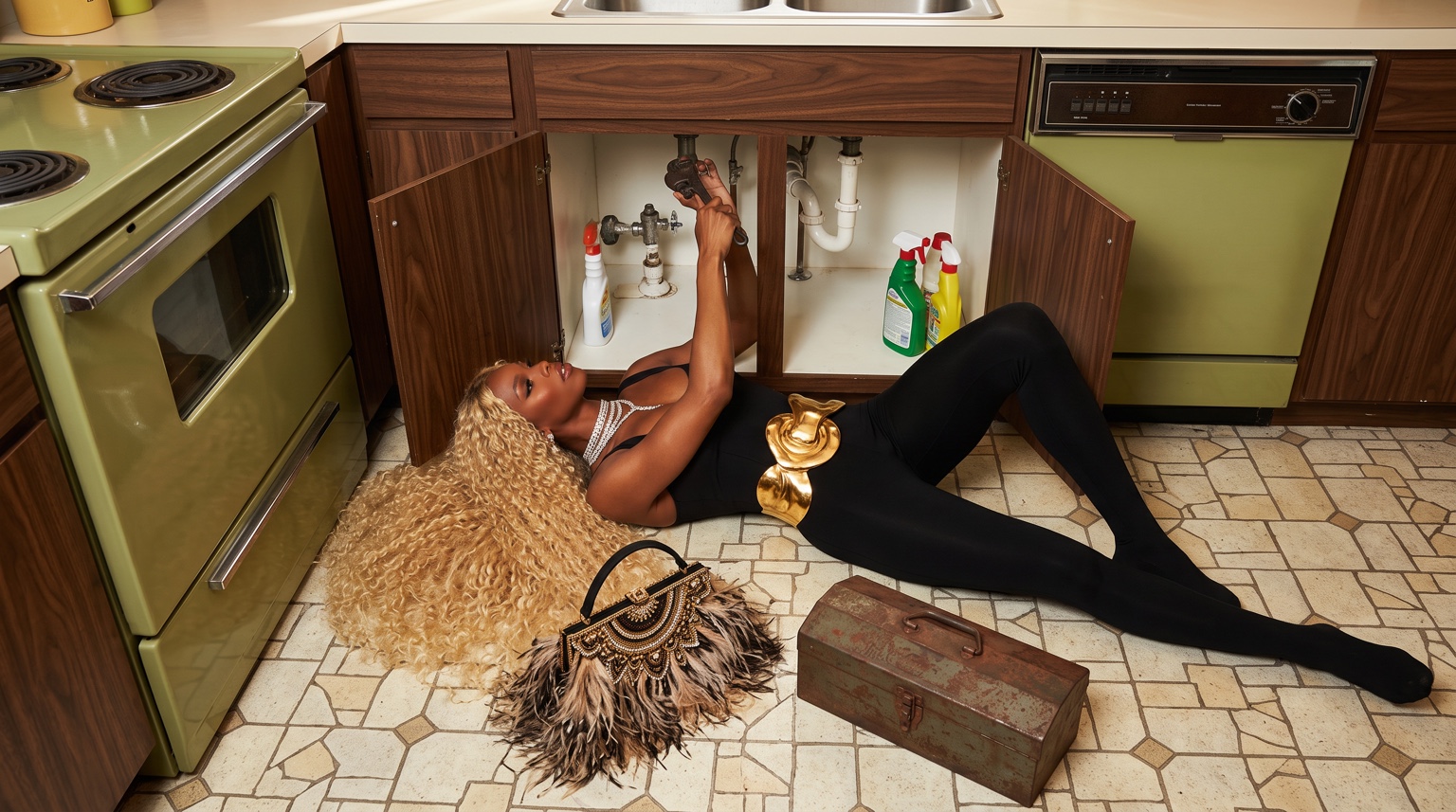
A woman recently told me to “go build a house or something.” She meant it as an insult, which is what made it so revealing. Somewhere in her understanding of manhood, physical labor represented a masculinity she did not see in me, or perhaps one she assumed I did not possess because I am openly gay, comfortable with femininity, and not particularly interested in performing hardness for strangers.
Here is the problem: had I responded by telling her to shut the fuck up, know her place, speak only when spoken to, get in the kitchen and make me a sandwich, nobody would need an academic journal to identify the misogyny. She would understand immediately that I was using an antiquated gender role to diminish her. So would everyone watching.
Yet “go build a house” is somehow supposed to exist outside that same conversation.
Why?
Both statements rely on the same premise: your gender comes with obligations, and I get to question your legitimacy when you refuse to perform them for me. Her womanhood should not be measured by domestic service, but somehow my manhood can be measured by physical labor. She is entitled to reject the kitchen, but I am supposed to report to the construction site.
That contradiction interests me far more than the insult.
There is a strain of gender politics where patriarchy becomes objectionable only when women receive the restrictions and strangely desirable when men receive the assignment. A woman should not have to be submissive, but a man should lead. She should not be confined to domestic labor, but he should provide. She should be emotionally liberated, but he should remain stoic. She can reject traditional femininity entirely and remain unquestionably a woman, while a man who embraces femininity risks having his manhood placed under review.
At some point we have to admit that this is not a rejection of rigid gender roles. It is an attempt to renegotiate who benefits from them.
And gay men make that contradiction difficult to hide.
I can wear makeup and know how to use power tools. I can understand hair, fashion and beauty and still know how to repair something. I can be emotionally articulate without being incapable of protecting myself or anyone I love. None of those qualities are opposites until somebody decides masculinity requires the absence of femininity.
Perhaps that is why the existence of feminine gay men bothers certain people so much. We expose how much of what gets called “manhood” is actually theater.
The man who refuses to communicate gets called stoic. The man terrified of vulnerability gets called strong. The man who cannot process an emotion without converting it into anger gets called masculine. Then a gay man who knows himself, communicates clearly and does not regard femininity as humiliating is somehow the one who needs lessons in being a man.
That math has never made sense to me.
The point is not that Black women created patriarchy. They did not. The point is that being oppressed by a system does not prevent you from learning its language, absorbing its values or using its rules against somebody else. Black people can reproduce racism. Gay men can reproduce misogyny. Women can reproduce patriarchal ideas about men. None of us receive intellectual immunity because we have experienced discrimination ourselves.
Which brings me back to the house.
I could build it.
But imagine how absurd it would be if I believed completing the house made me more of a man. Imagine measuring my gender by whether I could frame a wall, while insisting it would be misogynistic to measure a woman’s by whether she could make dinner.
So yes, tell me to build the house. But understand what happens when I apply your logic in reverse. If “men should build” is harmless common sense, then “women should cook” has to be harmless common sense too.
And if the second sentence made you angry, perhaps you finally understand how the fuck we feel.
I love us all.